
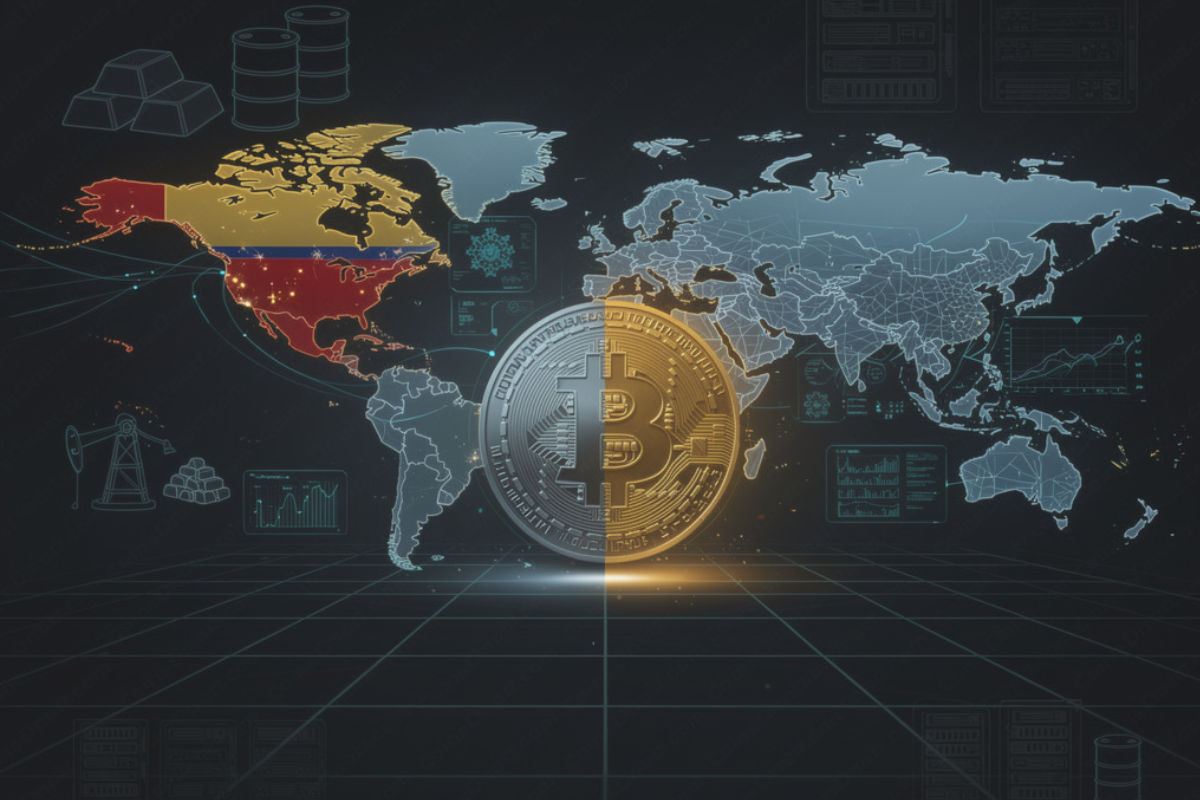
Venezuela's Alleged Crypto Hoard: US National Security Review Contrasts Whale Hunting Report with Blockchain Data
U.S. officials are actively examining potential assets linked to the Nicolás Maduro regime in Venezuela, with digital currencies among the categories under review, according to Patrick Witt, Executive Director of the President's Council of Advisors for Digital Assets. In a recent interview with CoinDesk, Witt confirmed that multiple national security teams are engaged in the investigation but declined to provide specifics on operational details or actions taken to date.
Official Investigation: Developing Status and Scope
Witt characterized the inquiry as an ongoing, multi-agency effort focused on understanding how the Maduro regime was financed and where associated assets—whether in physical commodities like oil and gold, or in digital form—may currently reside.
"Folks are talking, they're looking at the situation overall, how the Maduro regime was financed, and where some of those assets, whether it's on the oil side, actual physical commodities, or digital assets may be," Witt stated. "I can't comment on anything there as of now, but there's a number of folks in the national security apparatus engaged and looking into that."
The investigation follows Maduro's capture earlier in 2026, an event that has intensified scrutiny of the regime's financial networks and sparked widespread speculation regarding potential cryptocurrency holdings. While Witt's comments confirm official interest, they stop short of validating any specific claims about asset volumes or locations.
The $60 Billion Claim: Allegations and Alleged Mechanisms
A report from Whale Hunting—a newsletter and podcast produced by Project Brazen that investigates hidden financial networks—has suggested that Venezuela's government under Maduro may have secretly amassed a Bitcoin reserve potentially valued at up to $60 billion.
According to the report, this alleged stash was accumulated through several purported channels:
Alleged Mechanism | Description |
|---|---|
Gold Sales | Proceeds from state gold exports allegedly converted to Bitcoin via opaque intermediaries |
Oil-for-Crypto Transactions | Barter arrangements wherein oil shipments were exchanged directly for digital assets |
Seized Mining Operations | Domestic Bitcoin mining infrastructure reportedly nationalized and operated for state benefit |
Key Facilitator | Alex Saab, a Maduro ally, allegedly played a central role in accessing and managing these assets |
These allegations, if substantiated, would represent one of the largest sovereign cryptocurrency holdings ever documented. However, the report itself acknowledges that much of the underlying activity would, by design, be difficult to trace through conventional financial or on-chain analytics.
Public Data: A Stark Contradiction
Publicly available blockchain data presents a markedly different picture. According to BitcoinTreasuries.NET—a tracker of known government and corporate Bitcoin holdings—Venezuela is listed as holding approximately 240 BTC, valued at roughly $21 million at prevailing prices.
This figure is orders of magnitude smaller than the $60 billion claim (which would imply holdings of roughly 670,000 BTC at $90,000 per coin). The discrepancy raises fundamental questions about methodology, attribution, and the limits of public blockchain transparency.
Blockchain Analytics Perspective: Skepticism Grounded in On-Chain Evidence
Major blockchain intelligence firms have expressed caution regarding the $60 billion assertion. Representatives from Nansen and Chainalysis have noted that:
Lack of On-Chain Corroboration: No publicly identifiable wallet clusters or transaction patterns currently support the existence of a sovereign-scale Bitcoin reserve attributable to Venezuela.
Attribution Challenges: Even if large holdings exist, sophisticated obfuscation techniques—including mixers, chain-hopping, and non-custodial storage—can render them invisible to standard analytics.
Burden of Proof: Extraordinary claims require extraordinary evidence; absent verifiable on-chain signals, skepticism remains the analytically prudent stance.
These firms emphasize that blockchain transparency is powerful but not absolute: while all transactions are public, linking addresses to real-world entities often requires supplementary intelligence beyond raw chain data.
Analytical Framework: Evaluating Sovereign Crypto Holdings Claims
For investors, policymakers, and observers assessing reports of state-level cryptocurrency accumulation, several methodological considerations warrant emphasis:
Source Hierarchy: Distinguish between investigative journalism (which may rely on confidential sources), official government statements, and verifiable on-chain data. Each carries different evidentiary weight.
Attribution Uncertainty: Blockchain addresses are pseudonymous; linking them to specific governments requires corroborating intelligence that is rarely public.
Obfuscation Capabilities: State actors with technical resources can employ advanced privacy techniques that limit the effectiveness of standard analytics.
Incentive Structures: Consider why a claim is being made—geopolitical messaging, market influence, or genuine investigative findings can produce divergent narratives.
Forward Considerations: What Could Clarify the Picture?
Several developments could help resolve the current uncertainty:
Potential Development | Impact on Assessment |
|---|---|
Official U.S. Disclosure | Formal identification of seized or sanctioned crypto assets would provide authoritative validation |
On-Chain Attribution Breakthrough | Analytics firms linking large wallet clusters to Venezuelan entities would strengthen the $60B hypothesis |
Whistleblower or Leaked Documentation | Internal regime records could corroborate or refute alleged accumulation mechanisms |
Market Impact Signals | Unexplained large transfers from known Venezuelan-associated addresses could signal movement of hidden reserves |
Until such evidence emerges, the gap between allegation and verification will persist.
Conclusion: Verification Over Speculation
The U.S. investigation into Maduro-linked digital assets confirms official interest in tracing the regime's financial networks—but it does not, at this stage, validate specific claims about the scale of cryptocurrency holdings. The $60 billion figure advanced by Whale Hunting represents a compelling investigative hypothesis, yet it remains uncorroborated by public on-chain data or official disclosure.
For market participants and observers, the prudent approach is to:
Monitor official channels for authoritative updates on asset seizures or sanctions
Treat unverified claims with appropriate skepticism while acknowledging the limits of public blockchain transparency
Recognize that sovereign crypto strategies, if they exist, are likely designed to evade easy detection
In complex, opaque domains like state-level digital asset accumulation, verification often lags behind allegation. Patience and evidentiary rigor remain the most reliable guides.
Disclaimer: This report is for informational purposes only and does not constitute financial, legal, or investment advice. Cryptocurrency markets are highly volatile and subject to rapid change; readers should conduct independent research, verify claims through primary sources such as official government communications, blockchain explorers, and reputable analytics platforms, and consult qualified professionals before making allocation decisions. Allegations regarding sovereign asset holdings involve significant uncertainty and should not be interpreted as confirmed facts. Digital asset investments involve substantial risk of loss, including potential total loss of principal.