
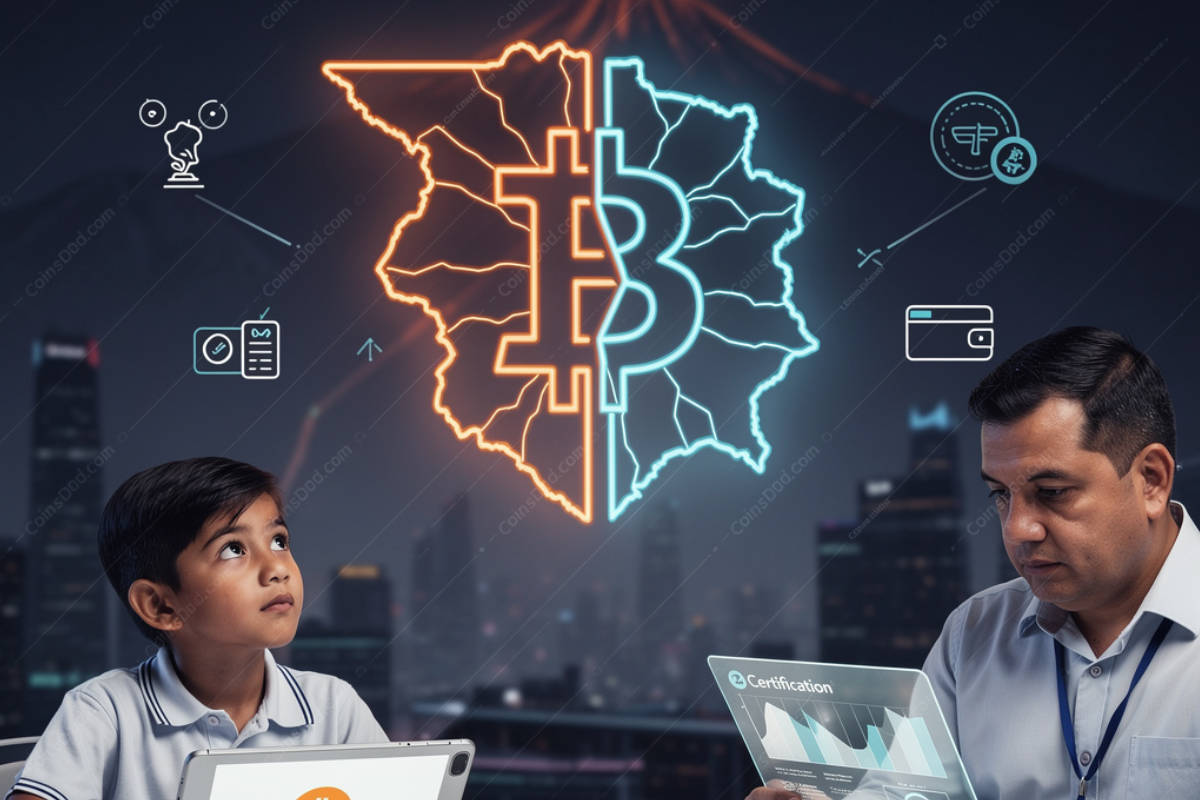
El Salvador Launches Bitcoin Diploma 2.0: Educational Push Continues Amid Challenged Adoption Metrics
El Salvador has officially launched "Bitcoin Diploma 2.0," an updated version of its national Bitcoin education program, with printed materials set for distribution across the country's school system in the coming days. The initiative represents the government's continued commitment to Bitcoin literacy despite mounting evidence that transactional adoption among Salvadorans remains limited nearly five years after the cryptocurrency became legal tender.
Stacy Herbert, Director of El Salvador's National Bitcoin Office, announced the development on social media platform X, emphasizing that the program employs age-appropriate teaching methods to make complex Bitcoin concepts accessible to younger students. The curriculum will integrate with broader educational initiatives, including the "What is Money?" course for children as young as seven years old, CUBO+, and the Higher School of Innovation in Public Administration (ESIAP) for civil servants.
"From 7 year old students studying, 'What is Money?' to 80,000 adult civil servants receiving a 3-day certification program on bitcoin, the new El Salvador keeps building something extraordinary," Herbert stated.
Bitcoin Diploma 2.0: Curriculum and Scope
The updated program covers foundational and advanced Bitcoin topics, including:
Topic Area | Content Focus | Target Audience |
|---|---|---|
Mining Fundamentals | Proof-of-work, energy consumption, network security | Secondary students, adults |
Economic Incentives | Game theory, block rewards, transaction fees | Advanced students, civil servants |
Monetary Economics | Fiat vs. Bitcoin, inflation, sound money principles | All levels, age-adapted |
Global Financial Systems | Banking, remittances, cross-border payments | Secondary and adult learners |
Practical Application | Wallet usage, private key management, transaction design | Hands-on modules for older students |
The program's expansion to younger demographics marks a significant escalation in El Salvador's Bitcoin education strategy, positioning cryptocurrency literacy as a core competency alongside traditional subjects.
Bitcoin Diploma 1.0: Legacy and Partnership Dissolution
The original Bitcoin Diploma program launched in June 2022 as a pilot in public schools, offering a 10-week course on Bitcoin fundamentals. The initiative was developed in collaboration with Mi Primer Bitcoin (My First Bitcoin), a Salvadoran nonprofit focused on creating open-source Bitcoin educational materials.
Program Achievements (2022–2024):
Metric | Achievement | Context |
|---|---|---|
Total Students Educated | 27,000+ | Face-to-face instruction across El Salvador |
Female Graduates (2024) | 350 | Specific cohort completion reported |
Geographic Reach | National | Public schools across multiple departments |
Partnership Duration | June 2022 – April 2024 | Collaboration ended after ~2 years |
In April 2024, the collaboration between Mi Primer Bitcoin and the Salvadoran government concluded, with the nonprofit's role in the program ending. The reasons for the partnership dissolution were not publicly disclosed, though the transition to an in-house "Bitcoin Diploma 2.0" suggests the government sought greater direct control over curriculum development and implementation.
The Adoption Paradox: Education Expands While Usage Stagnates
Despite El Salvador's pioneering status as the first nation to adopt Bitcoin as legal tender (September 2021) and its substantial investment in education and infrastructure, transactional adoption among Salvadorans remains remarkably low. Multiple independent studies reveal a persistent gap between policy ambition and practical usage:
Chivo Wallet Adoption Metrics:
Study/Finding | Statistic | Implication |
|---|---|---|
Post-Bonus Retention | Only 20% continued using Chivo after spending $30 signup bonus | Incentive-driven adoption, not organic demand |
Transaction Usage (2024) | 92% of Salvadorans still refrain from using Bitcoin for transactions | Legal tender status has not translated to everyday use |
Bonus as % of Income | $30 represented ~0.7% of annual income per capita | Significant incentive relative to household budgets |
Primary Adoption Driver | $30 bonus, not utility or conviction | Transactional use remains minimal without subsidies |
Researcher Assessment:
"The main driver of adoption for households is reported to be the $30 bonus, equivalent to 0.7% of annual income per capita," noted researchers in a multi-author study on Chivo wallet usage.
Additional challenges identified in academic literature include:
Technical Issues: The Chivo wallet experienced frequent glitches, crashes, and usability problems that frustrated early adopters
Merchant Acceptance: Despite legal requirements, many businesses remain reluctant to accept Bitcoin due to volatility concerns
Financial Literacy Gap: Understanding Bitcoin's technical and economic properties remains challenging for average users
Deferred or Failed Strategic Initiatives
Beyond the Chivo wallet's limited adoption, several flagship components of El Salvador's Bitcoin strategy have encountered significant obstacles:
1. Volcano Bonds
Aspect | Original Plan | Current Status |
|---|---|---|
Announced | November 2021 | — |
Target Size | $1 billion | — |
Purpose | Fund Bitcoin City and national BTC purchases | — |
Timeline | Expected 2022 launch | Delayed March 2022; no subsequent updates |
Investor Appetite | Anticipated strong demand | Limited interest; concerns over structure and risk |
Current Status | — | Effectively shelved; no active development |
2. Bitcoin City
Aspect | Original Plan | Current Status |
|---|---|---|
Announced | November 2021 by President Nayib Bukele | — |
Location | Near Conchagua volcano (La Unión department) | — |
Energy Source | Geothermal power for Bitcoin mining | — |
Financing | Volcano Bond proceeds | Bonds delayed; funding uncertain |
Construction Status | Expected to begin 2022–2023 | Significant delays; limited visible progress |
Environmental Concerns | — | Mangrove ecosystem threats from associated airport infrastructure |
Social Impact | — | Forced relocations of local residents; land clearing controversies |
3. Recent Bitcoin Purchases
Metric | Status | Source |
|---|---|---|
Last Public BTC Purchase | December 2024 | Cryptopolitan report |
Recent Reserve Changes | Attributed to internal wallet transfers, not new acquisitions | IMF report |
Transfer Activity | Movements between Strategic Bitcoin Reserve Fund and Chivo e-wallet | On-chain analysis |
The International Monetary Fund's observation that apparent increases in El Salvador's Bitcoin reserves resulted from internal consolidations rather than new purchases suggests the government's accumulation strategy may have paused or slowed significantly.
Bitcoin Diploma 2.0: Can Education Bridge the Adoption Gap?
The launch of Bitcoin Diploma 2.0 raises a critical question: Can comprehensive education drive transactional adoption when infrastructure, incentives, and voluntary usage have thus far proven insufficient?
Arguments for Educational Impact:
Potential Benefit | Mechanism | Timeline |
|---|---|---|
Long-Term Cultural Shift | Younger generations internalize Bitcoin as normal monetary tool | 10–20 years |
Technical Literacy | Students gain practical skills for wallet usage, security, transactions | 5–10 years |
Economic Understanding | grasp of sound money principles may increase voluntary adoption | Uncertain |
Civil Servant Training | 80,000 officials certified could improve government service delivery | 2–5 years |
Challenges and Limitations:
Obstacle | Explanation | Mitigation Difficulty |
|---|---|---|
Infrastructure Gaps | Education doesn't resolve Chivo's technical issues or merchant acceptance | High |
Volatility Concerns | Understanding Bitcoin doesn't eliminate price risk for daily transactions | High |
Economic Necessity | Salvadorans prioritize reliable payment methods for essential goods | High |
Incentive Dependency | Past adoption driven by $30 bonus, not conviction or utility | Moderate |
Generational Lag | Children educated today won't enter workforce for 10+ years | Structural |
Analytical Framework: Education vs. Adoption Dynamics
Prudent analysis requires distinguishing between educational success and transactional adoption:
Metric | Current Status | Target (Implicit) | Gap |
|---|---|---|---|
Students Educated | 27,000+ (v1.0); expanding with v2.0 | Universal coverage? | Scaling ongoing |
Bitcoin Transaction Usage | 8% of population | Majority adoption? | 92% non-usage persists |
Chivo Active Users | ~20% post-bonus retention | Sustainable engagement? | 80% churn after incentive |
Merchant Acceptance | Legally required; practically inconsistent | Universal acceptance? | Voluntary compliance low |
Government BTC Holdings | Paused since Dec 2024 | Continued accumulation? | Unclear strategy |
This divergence suggests that while El Salvador has made notable progress in Bitcoin education, the translation to Bitcoin usage remains the central challenge.
Forward Considerations: Variables to Monitor
For observers evaluating El Salvador's Bitcoin strategy through 2026 and beyond, several indicators merit attention:
Variable | Bullish Signal | Bearish Signal |
|---|---|---|
Bitcoin Diploma 2.0 Rollout | Wide distribution; high student engagement; measurable knowledge retention | Limited implementation; low participation; curriculum controversies |
Chivo Wallet Metrics | Organic usage growth beyond bonus recipients; technical improvements; merchant adoption increases | Continued 90%+ non-usage; persistent technical issues; merchant non-compliance |
Government BTC Strategy | Resumption of transparent purchases; clear accumulation policy; IMF cooperation | Extended purchase hiatus; reliance on internal transfers; fiscal pressure to liquidate |
Volcano Bonds / Bitcoin City | Revival with credible financing; construction milestones achieved | Permanent shelving; environmental litigation; community opposition intensifies |
Economic Indicators | Remittance costs decline via Bitcoin; financial inclusion improves; GDP growth accelerates | Dollarization pressures increase; fiscal deficits widen; credit ratings deteriorate |
Conclusion: Education as Long-Term Bet Amid Short-Term Realities
El Salvador's Bitcoin Diploma 2.0 represents a significant investment in the next generation's financial literacy, with the potential to cultivate a population that understands and potentially embraces Bitcoin as a monetary tool. However, the program's success must be evaluated within the broader context of El Salvador's Bitcoin experiment:
Educational Achievement ≠ Transactional Adoption: Teaching Bitcoin concepts does not automatically translate to voluntary usage for daily transactions.
Infrastructure and Incentives Matter: Even with education, technical reliability, merchant acceptance, and economic utility remain prerequisites for sustained adoption.
Generational Timeline: The full impact of Bitcoin education may not materialize for 10–20 years, requiring sustained political commitment across multiple administrations.
Fiscal Realities: With Bitcoin purchases paused and major initiatives (Volcano Bonds, Bitcoin City) stalled, the government's capacity to maintain its Bitcoin strategy depends on broader economic performance and external financing.
For El Salvador, Bitcoin Diploma 2.0 is both an educational initiative and a statement of long-term conviction. Whether that conviction translates into widespread adoption—or remains a pioneering experiment with limited practical impact—will depend on factors beyond curriculum design: infrastructure reliability, economic incentives, technological evolution, and the lived experience of Salvadorans navigating daily financial decisions.
Disclaimer: This report is for informational purposes only and does not constitute financial, legal, or investment advice. El Salvador's Bitcoin policies and educational programs are subject to change based on governmental decisions, economic conditions, and regulatory developments. Readers should verify information through primary sources such as official government communications, academic research publications, and reputable news outlets. Cryptocurrency investments involve substantial risk of loss, including potential total loss of principal. Educational program outcomes may vary and do not guarantee future economic or technological adoption.