
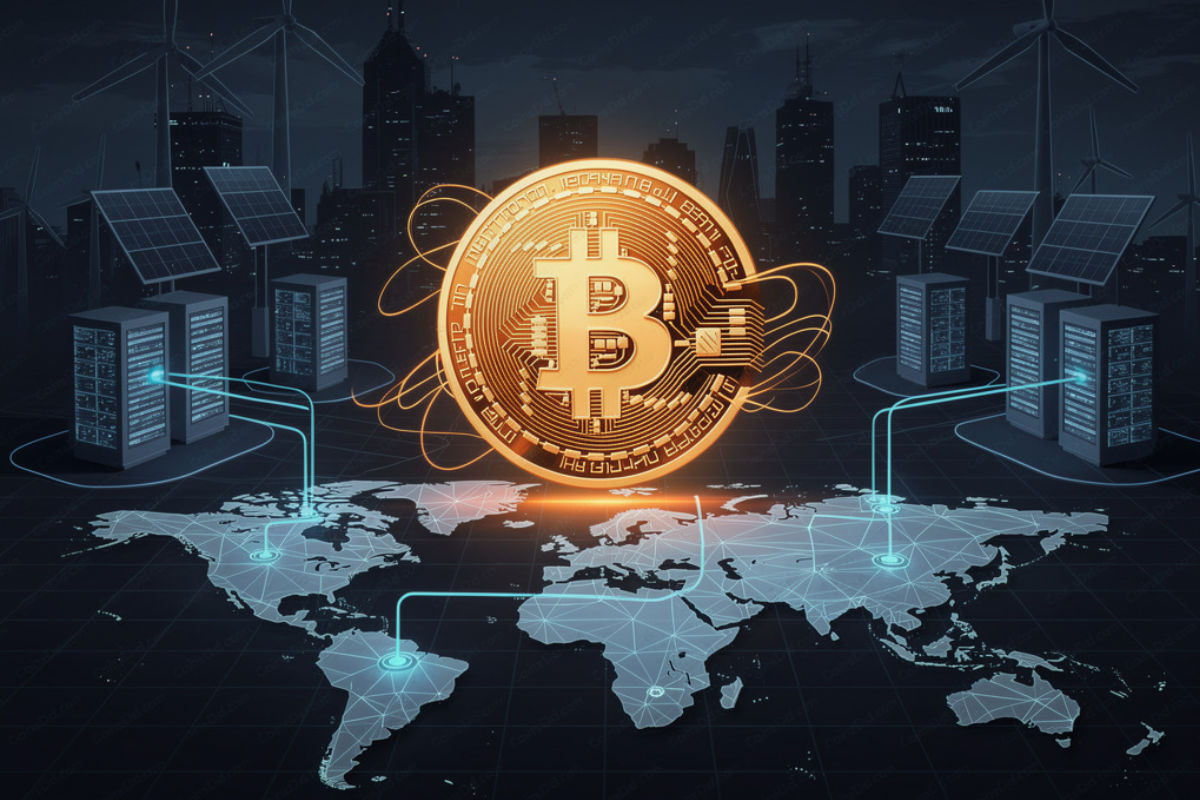
Beyond the Moral Debate: How Sovereign Capital, Flare-Gas Mining, and Demand Response Are Reshaping Bitcoin's Energy Narrative
CryptoQuant CEO Ki Young Ju has reignited a foundational thesis in Bitcoin discourse: that proof-of-work mining is not merely a consensus mechanism, but a digital instrument for precisely measuring and monetizing energy—a capability that could prove critical in an AI-accelerated economy where power, not narratives, is the binding constraint.
In a recent social media post, Ju framed Bitcoin as a unique monetary technology:
"Energy is money. Bitcoin precisely measures the value of energy. Gold also embeds energy, but it cannot be measured accurately because it is not digital. Bitcoin is the money of an AI-accelerated energy economy."
Ju's commentary was paired with a long-form analysis by Hashed CEO Simon Kim, titled Monetizing Energy: Redefining Bitcoin's Role in the AI Era, which argues that the decade-old critique of Bitcoin as an "energy waste" is being overtaken by industrial pragmatism: the same infrastructure that secures the Bitcoin network may also solve critical challenges for AI data center deployment.
The Energy-Money Connection: Bitcoin as Digital Measurement
At the core of Ju's thesis is a distinction between physical and digital stores of value. While gold and other commodities embody energy in their extraction and refinement, their value cannot be programmatically verified or precisely quantified in real time. Bitcoin, by contrast, embeds energy expenditure into its consensus protocol in a transparent, auditable, and digitally native manner.
This property, Ju argues, positions Bitcoin as a potential settlement layer for an economy increasingly defined by energy scarcity:
Precision Pricing: Each Bitcoin transaction reflects verifiable energy input, creating a direct link between physical work and digital value.
Borderless Transfer: Unlike electricity, which suffers transmission losses and geographic constraints, Bitcoin can transport the economic value of energy anywhere with internet connectivity.
AI Alignment: As artificial intelligence systems demand exponential increases in reliable power, a monetary instrument that natively prices energy could facilitate more efficient capital allocation across compute, storage, and transmission infrastructure.
From Moral Critique to Grid Economics: Kim's Reframing
Simon Kim's analysis builds on Ju's foundation by arguing that the debate over Bitcoin's energy use has fundamentally shifted—from moral condemnation to industrial economics.
"The oldest criticism of Bitcoin has always been about energy. Claims that it 'wastes electricity,' 'destroys the environment,' and 'competes with data centers for power' have been repeated for over a decade, solidifying into conventional wisdom. But in 2026, this debate no longer resides in the realm of moral condemnation."
Kim contends that capital flows now tell a different story. He highlights several developments that signal a pragmatic reassessment of mining infrastructure:
Development | Significance |
|---|---|
Mubadala's $437M BTC ETF Allocation (Q4 2024) | Sovereign capital treating Bitcoin as a strategic reserve asset |
Mubadala-Oman Partnership with Crusoe Energy | First flare-gas mining operation in the Middle East, monetizing wasted energy |
Crusoe's $1.375B Series E (Oct 2025) | Valuation >$10B; subsequent pivot to focus on AI infrastructure, validating mining's operational expertise |
Elon Musk Quote (Nov 2025) | "Energy is the true currency… You can't just pass a law and suddenly have a lot of energy" |
The throughline: miners have already solved hard problems—securing power contracts, mastering high-density thermal management, and building operational muscle around flexible load—that AI data centers now urgently need.
Mining as Grid Flexibility: The Interruptible Load Advantage
A recurring theme in Kim's analysis is that electricity's inherent constraints—locality, immediacy, and transmission losses—make flexibility economically valuable. Bitcoin miners, by design, can power up or down within seconds, making them ideal "buyers of last resort" for energy that cannot be stored or transmitted.
Global Curtailed Energy: Kim cites estimates that curtailed renewable energy exceeds 200 TWh annually worldwide, representing over $20 billion in economic losses. Bitcoin mining offers an instant monetization path for this surplus generation.
Texas Case Study: Kim points to ERCOT's classification of mining as a controllable load resource:
During the 2022 winter storm, Riot Blockchain reduced power usage by 98–99%, helping stabilize the grid.
In an August 2023 heatwave, the company received $31.7 million in power credits for demand response—more than it would have earned mining that month.
This framing shifts the narrative from "miners versus data centers" to "premium uptime workloads versus interruptible demand that stabilizes the grid." AI training clusters require continuous, high-availability power; miners can absorb volatility, creating a complementary relationship rather than a zero-sum competition.
Environmental Evolution: Mix Shifts and Emissions Arbitrage
Kim also argues that the environmental critique of Bitcoin is evolving as the industry's energy mix shifts:
Metric | Historical | Current (Claimed) |
|---|---|---|
Sustainable Energy Share | ~40% (est. 2021) | >52% |
Coal Dependence | ~36% | <9% |
Methane Flaring vs. Mining | 93% combustion efficiency; 7% methane escape | >99% combustion efficiency; >60% lower CO₂-equivalent emissions |
On methane specifically, Kim describes flare-gas mining as an "emissions arbitrage": methane has approximately 80 times the greenhouse effect of CO₂ over a 20-year horizon. Traditional flaring combusts ~93% of the gas, with 7% escaping unburned. Using that same gas for mining achieves >99% combustion efficiency, reducing CO₂-equivalent emissions by over 60% compared to flaring alone.
This does not eliminate environmental concerns, but it reframes mining as a potential tool for emissions reduction in specific contexts—particularly where stranded or wasted energy would otherwise be vented or flared.
AI Era Implications: Where Miners Fit in the Infrastructure Stack
The forward implication of Ju and Kim's framing is that if AI accelerates the premium on reliable power and rapid infrastructure deployment, Bitcoin's value proposition may increasingly be argued in the language of energy markets: measuring, monetizing, and transporting scarcity.
Kim's closing challenge is explicit:
"Shift the question from consumption totals to system outcomes. The next phase of the debate will center on where miners sit in the stack of AI-era infrastructure, not whether they exist."
He continues:
"AI operates where continuous uptime is essential; Bitcoin operates where flexibility has value. Governments can print money, but they cannot print energy. Bitcoin's proof-of-work is the mechanism that brings this physical reality into the digital economy. It's a technology that takes energy from one place and transports it anywhere."
This reframing positions Bitcoin not as a competitor to AI, but as a complementary layer: miners secure the grid and monetize stranded energy; AI clusters consume reliable, high-quality power for computation. Both require energy; both benefit from more efficient allocation.
Analytical Balance: Opportunities and Considerations
While the energy-AI-Bitcoin thesis is compelling, prudent analysis requires acknowledging several considerations:
Constructive Signals:
Capital flows from sovereign wealth funds suggest institutional reassessment of mining's strategic value
Demand response programs demonstrate tangible grid benefits from flexible mining loads
Environmental mix improvements indicate industry responsiveness to sustainability concerns
Caveats and Open Questions:
Attribution Complexity: Linking specific mining operations to grid stabilization or emissions reduction requires granular, verified data—not all claims are equally substantiated
Scalability Limits: While curtailed energy represents a large absolute figure (~200 TWh), it remains a small fraction of global generation; mining's role may be meaningful but not transformative at planetary scale
Regulatory Variability: Policy frameworks for demand response, emissions accounting, and energy monetization differ significantly across jurisdictions
Technological Evolution: Advances in battery storage, transmission, or AI efficiency could alter the relative value of mining flexibility over time
Forward Monitoring: Variables to Watch
For investors and observers evaluating this thesis, several indicators merit attention:
Sovereign Capital Flows: Continued allocations from state-linked funds to Bitcoin or mining infrastructure would reinforce the strategic narrative.
Grid Integration Programs: Expansion of demand response, capacity market participation, or ancillary services compensation for miners would validate the flexibility value proposition.
Environmental Verification: Third-party audits of energy mix claims and emissions accounting would strengthen credibility of sustainability arguments.
AI Infrastructure Partnerships: Collaborations between mining firms and AI data center developers could demonstrate practical complementarity.
Policy Developments: Regulatory frameworks that recognize mining's grid services or emissions reduction potential could accelerate adoption.
Conclusion: Reframing the Debate, Not Ending It
Ki Young Ju and Simon Kim's analysis offers a provocative reframing of Bitcoin's relationship to energy and artificial intelligence. By shifting the question from "How much energy does Bitcoin consume?" to "What system outcomes does mining enable?", they invite a more nuanced evaluation of proof-of-work infrastructure in an era of escalating power demand.
This perspective does not resolve all environmental, economic, or ethical questions surrounding Bitcoin. But it does challenge observers to move beyond binary judgments and consider how digital scarcity, physical scarcity, and technological innovation might interact in a resource-constrained future.
For investors, the takeaway may be methodological: evaluate claims against verifiable data, distinguish between aspirational theses and demonstrated outcomes, and maintain disciplined risk parameters regardless of conviction in any single narrative. In complex, adaptive systems like global energy and financial markets, preparation and multi-factor analysis often prove more valuable than ideological certainty.
Disclaimer: This report is for informational purposes only and does not constitute financial, legal, or investment advice. Cryptocurrency markets, energy infrastructure, and AI development are highly dynamic and subject to rapid change; readers should conduct independent research, verify claims through primary sources such as company disclosures, regulatory filings, and peer-reviewed research, and consult qualified professionals before making allocation decisions. Forward-looking statements involve inherent uncertainty and should not be interpreted as guarantees of future performance. Digital asset investments and energy project participation carry substantial risk of loss, including potential total loss of principal.